Not sure where to start?
Try the Personal Concerns Inventory (PCI) to clarify what to focus on, or start with Relaxation Therapy for guided meditation.

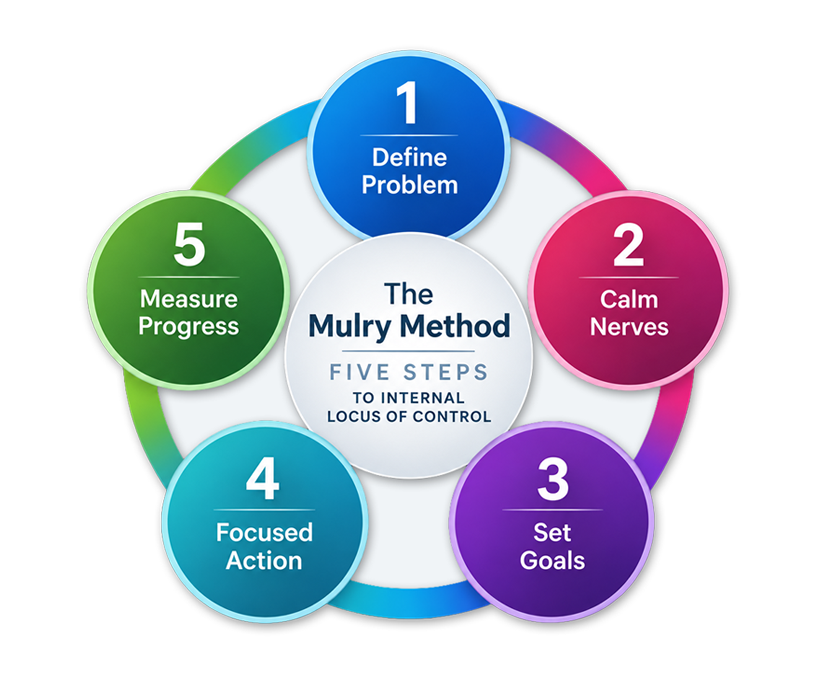
Developing an Internal Locus of Control means learning to recognize how your choices, actions, and expectations can influence what happens next. The Mulry Method turns that principle into a practical 5-step process for Self-Learning and positive change.
The process helps you identify what concerns you, become more relaxed, define what you want to accomplish, take Focused Action, and evaluate what happens. It reflects one of Dr. Reaume Carroll Mulry’s central principles: We become what we do.
You learn something. Through practice, you observe what happens and make adjustments. Then you practice again. Over time, this process helps you become a more effective Self-Learner and strengthens your Internal Locus of Control.
Dr. Mulry described his work as an integrated program that brought together psychological theory and techniques with active physical practices. Over decades, he refined this work into what he called a repeatable method built around five primary components.
Those five components form the structure of the Mulry 5-Step Method:
Psychologist Julian Rotter introduced Locus of Control within his work on Social Learning Theory. An Internal Locus of Control reflects an expectation that your own behavior can influence outcomes. An External Locus of Control places greater emphasis on forces outside your control, such as luck, circumstances, or the actions of other people.
Internal control does not mean believing you control everything that happens. Many circumstances are beyond your control. The important distinction is recognizing where your actions can make a difference and developing useful ways to respond.
This idea became an important foundation of the Mulry Method and its approach to Internal Locus of Control and Self-Learning. Rather than simply telling yourself to think positively or try harder, you identify concerns, understand your responses, develop a strategy, act on it, and evaluate the results.
Learn more about Julian Rotter and Social Learning Theory. You can also explore Internal and External Locus of Control in Lesson 17 of In The Zone Skills Training.
Before deciding what to do, you need to understand what concerns you. The Personal Concerns Inventory (PCI) helps you identify and prioritize concerns across important areas of your life.
With more than 1,000 possible concerns, the PCI provides a structured way to determine what deserves your attention. Rather than beginning with a vague feeling that something is wrong, you can identify a Primary Concern and use it as the starting point for Self-Learning.
In Social Learning Theory, expectancy refers to what you anticipate will happen in a particular situation. Negative expectancy can take different forms:
Expectations matter because they can influence what you do next. Anticipating failure may lead you to hesitate, avoid a situation, or stop trying. Your behavior can then affect the outcome and reinforce the original expectation.
Even familiar ideas can carry different meanings, expectations, and values from one person to another. A World Without Love illustrates this through one of the most familiar, yet difficult to define, concepts in everyday life.
Thoughts are only part of the experience. Your body is responding too. In Polyvagal Theory, neuroception describes the nervous system’s detection of cues associated with safety, uncertainty, or threat without requiring conscious awareness.
Imagine preparing for an important presentation while expecting that you will perform poorly. Your heart races, your palms sweat, and your stomach tightens. The negative expectancy and physiological response may begin reinforcing one another, increasing hesitation or avoidance.
Recognizing both provides useful information. Instead of treating the reaction as something that simply happens to you, you can learn how you respond and begin developing a more useful response.
To learn more about how these two concepts can be considered together, see Expectancy And Neuroception: Connecting Social Learning And Polyvagal Theory.
The PCI helps bring clarity to this process by identifying and prioritizing your Primary Concern. In about 20 minutes, it provides a structured picture of what concerns you. Your Primary Concern can then become the foundation for setting goals and developing Focused Action.
FOCUS captures what this first step is designed to accomplish. Defining the problem gives you something specific to work with rather than reacting to a vague sense of uncertainty.
With your Primary Concern identified, the next step is to work with the emotional and physiological responses that may interfere with effective action.
Emotions are not experienced only as thoughts. Tension, breathing, heart rate, posture, and other physiological changes can become part of an emotional response. Dr. Mulry developed Relaxation Therapy beginning in 1976 as a practical way to learn relaxation through repeated practice.
Relaxation Therapy uses rhythmic breathing, guided relaxation, body awareness, and sounds of nature to help you become more familiar with releasing tension. With practice, you learn to recognize the difference between tension and relaxation and become better prepared to respond when pressure rises.
Relaxation is not intended to make your concerns disappear. It is a skill that can help you become more Relaxed, Balanced, Flexible, and Focused so you are better prepared to deal with them.
This distinction is important to the Mulry Method. You are not simply trying to feel better. You are learning a useful response that can support clearer thinking, decision-making, and Focused Action.
Access the full collection of Relaxation Therapy recordings.
Once you have identified your Primary Concern and are better prepared to work with it, you can define what you want to accomplish. A concern identifies the problem. A goal gives you direction.
For example: “I’m drinking six drinks a day and want to reduce that to two.”
That goal provides something specific that can be acted upon and evaluated. A vague intention such as “I want to do better” does not provide the same direction.
Clear goals help you:
Goal-setting and Internal Locus of Control are closely connected. You are developing a strategy that can be put into practice and evaluated. A useful goal should eventually allow you to answer an important question: Did what I did make a difference?
Understanding a problem and setting a goal are not enough. At some point, what you have learned has to become action. Dr. Mulry called this Focused Action.
Focused Action is purposeful behavior directed toward what you are trying to accomplish. It connects what you have learned about yourself with what you actually do. This is where Internal Locus of Control becomes practical.
You cannot control every outcome, but you can identify actions available to you, choose a strategy, put it into practice, and observe the results. That might mean practicing a new skill, changing a familiar behavior, approaching something you have avoided, or responding differently to a recurring situation.
Repeated action gives you experience, and experience gives you information. You can use that information to decide what to do next. This is Self-Learning in action and an expression of Dr. Mulry’s principle: We become what we do.
The final step is not simply deciding whether you succeeded or failed. It is evaluating what happened and using that information to guide what you do next.
Return to your original concern and compare it with your goal. Consider the actions you took and what followed. By retaking the Personal Concerns Inventory over time, you can also see whether the importance or intensity of your concerns has changed. Your “This Is Me!” report provides a record that can help you observe those changes.
Measurement creates feedback, and feedback makes Self-Learning possible. You learn something, practice it, and observe what happens. Based on what you discover, you make adjustments and practice again.
If an approach works, you have evidence that it may be useful again. When it does not produce the result you expected, you have learned something valuable as well. You can reconsider your expectations, change your strategy, develop another skill, or try a different action.
Research on Locus of Control has examined its relationship with health behavior, achievement, coping, well-being, and performance. An Internal Locus of Control is generally associated with a stronger expectation that personal actions can influence outcomes.
The Mulry Method makes that principle practical by asking: What can you learn to do?
Internality is not about pretending circumstances do not matter or assuming that success depends entirely on you. It means recognizing where your behavior can have an effect and learning how to act effectively within those circumstances. This process can also help you build confidence through an Internal Locus of Control as experience provides evidence that your actions can make a difference.
The five steps create a practical sequence:
Concern → Relaxation → Goal → Focused Action → Feedback
The value of the process comes from feedback. Each attempt gives you information you can use to refine your expectations, strengthen useful skills, and choose what to do next.
For more of the psychological background, see Social Learning Theory And The Mulry Method.
The Mulry 5-Step Method does not promise that every problem can be solved or every outcome controlled. It provides a way to become more skillful in how you respond to the concerns and challenges you face.
By defining the problem, calming your nerves, setting clear goals, taking Focused Action, and measuring what happens, you turn experience into information you can use. Over time, practice can strengthen the connection between what you understand, what you intend to do, and what you actually do.
The Mulry Method Self-Care 10-Step Guide expands this process and connects it with other Self-Learning tools developed by Dr. Mulry. You can also watch the 10-Step Video Series and begin putting these principles into practice.
