Not sure where to start?
Try the Personal Concerns Inventory (PCI) to clarify what to focus on, or start with Relaxation Therapy for guided meditation.

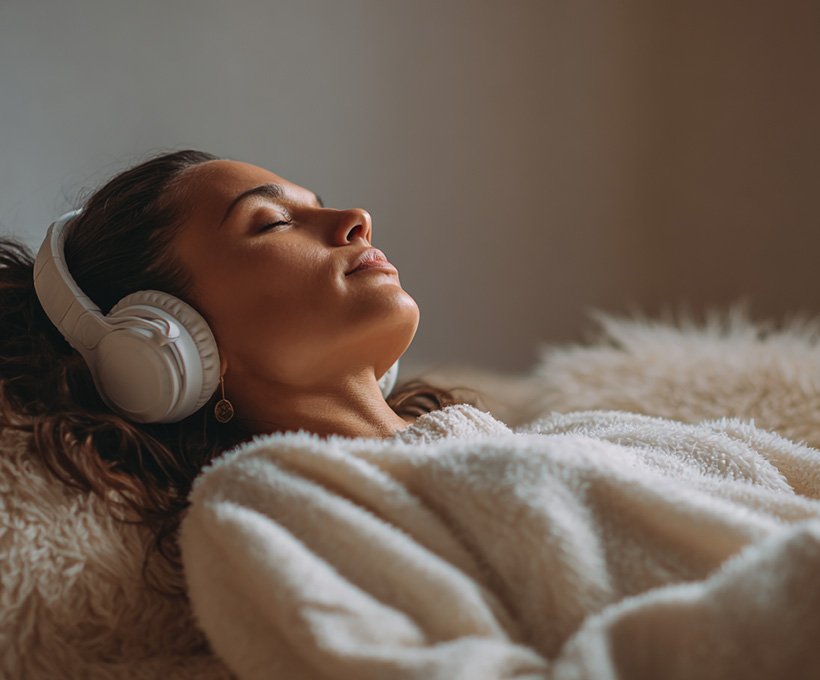
Relaxation Therapy offers a simple yet profound way to use guided meditation, rhythmic breathing, and body awareness to ease tension and settle the nervous system. Developed by Dr. Reaume Carroll Mulry beginning in the early 1970s, the program follows a structured induction built around rhythmic flow rather than passive stillness.
The guided sequence lasts about fifteen minutes and is followed by sounds of nature that allow relaxation to continue without verbal instruction. With repeated practice, relaxation becomes a learned skill. You become more aware of physical tension, more familiar with the feeling of releasing it, and better able to use relaxation as part of everyday self-management.
Access the full collection of Relaxation Therapy recordings.
Everyday life introduces pressures that can activate the body’s stress response. While this response is sometimes necessary, remaining physically and mentally tense can make it more difficult to feel Relaxed, Balanced, Flexible, and Focused.
Relaxation Therapy teaches you to recognize tension and practice letting it go. Rather than treating relaxation as something that simply happens, Dr. Mulry approached it as a skill that can be learned through experience and repetition.
This emphasis on learning connects Relaxation Therapy with the broader Mulry Method. As you become more aware of how your body responds to tension and relaxation, you gain useful information about yourself and develop greater ability to influence your response.
Relaxation Therapy engages the mind and body through a guided sequence that combines:
Together, these elements create conditions that support a shift from heightened activation toward a calmer physiological state. Stomach breathing and other relaxation techniques may also influence activity associated with the vagus nerve and the parasympathetic nervous system.
Polyvagal Theory helps explain how safety cues in the nervous system can support this shift, although you don’t need scientific knowledge to benefit from the practice.
Relaxation Therapy is based on the idea that relaxation can be learned.
With repeated practice, you become more familiar with how it feels to relax and more aware of the contrast between relaxation and tension. Over time, you develop the ability to relax when you need to, even without the guided recording.
This reflects an important principle of Self-Learning. We learn through experience and apply what we learn.
With regular practice, Relaxation Therapy can help you:
The objective is not to eliminate stress or remain relaxed all the time. It is to develop a practical relaxation skill you can use when you need it.
As the skill develops, you can begin applying relaxation in everyday situations without relying on the guided practice. What you learn through Relaxation Therapy can help you recognize tension and relax when you need to.
Learning how and when to relax can help you respond to tension before it becomes excessive and develop greater responsibility for your own well-being.
This is why Relaxation Therapy occupies an important place within the Mulry Method. It is not simply fifteen minutes of relaxation. It is a practical skill developed through experience and carried into everyday life.
Learn more in The Principles Of Relaxation Therapy, including the role of stomach breathing, rhythm, and the vagus nerve in the relaxation process.
