Not sure where to start?
Try the Personal Concerns Inventory (PCI) to clarify what to focus on, or start with Relaxation Therapy for guided meditation.

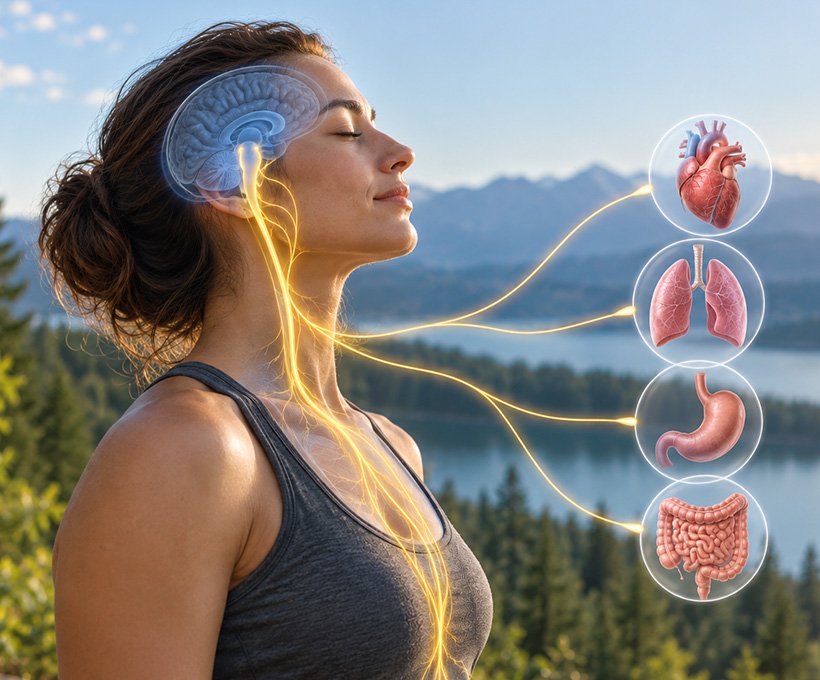
The vagus nerve is a major communication pathway between the brain and body. As part of the parasympathetic nervous system, it helps regulate heart function, digestion, breathing-related changes in heart rhythm, and the body’s recovery after stress.
Understanding this system helps explain some of the physiology behind stomach breathing, relaxation, and other mind-body skills used throughout the Mulry Method. These practices do more than encourage you to relax. They give you practical ways to influence how your body responds to stress and help you become more Relaxed, Balanced, Flexible, and Focused.
The vagus nerve is the tenth and longest cranial nerve. It begins in the brainstem and travels through the neck, chest, and abdomen, connecting the brain with the heart, lungs, and digestive tract, extending into portions of the large intestine.
Most vagal fibers carry sensory information from the body toward the brain. This ongoing communication helps the brain monitor conditions within the body and contributes to the regulation of physiological state.
The vagus nerve also carries signals from the brain back to the body. Through these two-way pathways, it participates in regulating heart rate, digestion, immune activity, and other functions involved in maintaining internal balance.
Polyvagal Theory offers an additional framework for understanding this regulation. It describes functionally distinct vagal pathways and considers how the nervous system responds to cues associated with safety, challenge, and threat.
Stress involves more than thoughts or emotions. It produces changes throughout the body. Heart rate may increase, breathing can become faster or shallower, muscles tighten, digestion changes, and attention becomes more focused on potential problems.
These responses are influenced by the autonomic nervous system.
The sympathetic nervous system helps mobilize the body for action. Parasympathetic pathways, including the vagus nerve, help regulate that activation and support recovery when increased mobilization is no longer necessary.
Vagal signals to the heart can slow heart rate through the release of acetylcholine. Parasympathetic activity also supports digestive processes and other restorative functions.
Healthy regulation is not a matter of remaining relaxed all the time. It is the ability to respond appropriately to changing circumstances and recover when the challenge has passed.
Polyvagal Theory, developed by Dr. Stephen Porges, provides one way of looking at how autonomic regulation may influence behavior, emotion, and social engagement.
The theory distinguishes between ventral and dorsal vagal pathways. The ventral vagal system is associated with physiological regulation that supports calm engagement and social interaction. The dorsal vagal system contributes to regulation of internal organs and, within Polyvagal Theory, is also associated with energy-conserving responses under extreme challenge.
These responses should not simply be labeled good or bad. The nervous system continually adjusts according to information coming from both inside and outside the body.
This idea connects naturally with the Mulry Method. Learning to recognize your own patterns gives you an opportunity to develop more useful responses rather than being controlled by automatic reactions.
The term vagal tone generally refers to the influence of the vagus nerve on physiological regulation, particularly the heart.
Heart Rate Variability, or HRV, is frequently used to study autonomic regulation. HRV measures variations in the time between heartbeats. Certain measures of HRV can provide information about parasympathetic influences on the heart, although HRV is not a simple or complete measurement of vagus nerve function.
The important idea is flexibility.
A well-regulated nervous system can adjust to changing demands and recover when those demands decrease. Instead of trying to remain in one state, the goal is to develop the capacity to move appropriately between activation, recovery, rest, and purposeful action.
This ability to adapt is closely related to what the Mulry Method describes as becoming Relaxed, Balanced, Flexible, and Focused.
Breathing is unusual because it occurs automatically but can also be consciously changed. This gives you a practical way to influence processes that normally operate outside conscious control.
Breathing and heart rate are closely linked. During inhalation, heart rate typically increases slightly. During exhalation, it typically decreases. This pattern, known as respiratory sinus arrhythmia, reflects interaction between breathing and autonomic regulation, including vagal influence on the heart.
Slow, comfortable breathing can strengthen this natural rhythm. It can also interact with pressure-sensitive baroreceptors in the cardiovascular system, which participate in regulating blood pressure and autonomic activity.
The goal is not to force a particular physiological response. It is to create conditions that support regulation.
This is one reason stomach breathing is such a useful skill. Allowing the abdomen to move naturally with the breath encourages slower, easier breathing and reduces the tendency to hold the stomach rigidly during tension or stress.
Dr. Reaume Carroll Mulry incorporated stomach breathing into his work long before the vagus nerve became a popular subject in wellness discussions.
Within the Mulry Method, breathing is not treated as an isolated technique. It is part of learning how to recognize tension, release unnecessary effort, regulate yourself, and prepare for effective action.
The Soft Stomach Breathing lesson in In The Zone Skills Training teaches this process directly. Rather than forcing deep breaths, the emphasis is on allowing the stomach to soften and breathing to become easier and more rhythmic.
With practice, breathing becomes something you can use when you recognize tension building. You are learning a useful response that can gradually become more natural.
We become what we do.
The same principle is central to Relaxation Therapy.
Dr. Mulry’s Relaxation Therapy combines rhythmic breathing, physical release, body awareness, and guided attention. These elements help reduce unnecessary muscular effort while creating conditions that support parasympathetic regulation and recovery from stress.
Repeated practice is important because relaxation is not simply something that happens to you. It can become a learned skill.
As you become more familiar with the physical difference between tension and relaxation, you become better able to recognize your own state and respond intentionally. That awareness is an important part of Self-Learning.
For a closer look at the method itself, read Relaxation Therapy: What It Is And How It Works.
The Mulry Method goes beyond relaxation. Regulation creates a better starting point for learning and action.
When stress is high, attention can narrow and automatic reactions can become more dominant. When you are more regulated, it may be easier to observe what is happening, consider alternatives, and choose a useful response.
That connects nervous system regulation with Social Learning Theory. Experience helps shape expectations, and expectations influence behavior. Becoming aware of those patterns gives you more information to work with.
The Personal Concerns Inventory provides another part of this process by helping you identify concerns that matter to you. Relaxation and mind-body skills can then support the ability to approach those concerns with greater awareness and self-command.
The goal is not to eliminate stress. It is to develop more useful ways of responding to it.
You cannot determine vagus nerve activity simply by how you feel, but changes in autonomic state can produce noticeable experiences.
As activation decreases, breathing may become slower and more comfortable. Muscular tension may ease. Heart rate may settle. Attention may become less scattered, and it may become easier to engage with what is happening around you.
These experiences are not proof that a particular branch of the vagus nerve has been activated. They are better understood as possible signs that the body is moving toward a more regulated state.
Learning to notice these changes develops body awareness. Over time these patterns become easier to recognize. The Vagus Nerve lesson in In The Zone Skills Training shows how this understanding applies in practice.
Understanding the vagus nerve gives you a clearer picture of the connection between mind and body. Stress is not only something you think about. It involves breathing, muscle tension, heart function, attention, digestion, expectations, and patterns of response.
The Mulry Method brings these elements together through Self-Learning and practice.
When you use stomach breathing or Relaxation Therapy, you are working with your biology rather than fighting against it. Recognizing tension and automatic reactions gives you information about yourself. Practicing a more useful response turns that information into action.
No single breathing exercise or relaxation technique controls the nervous system. The value comes through learning, repetition, and experience.
With practice, useful responses can become more familiar and easier to access when you need them. You become better able to recognize your state, adjust to changing circumstances, and take purposeful action.
That is the larger goal of the Mulry Method: developing the awareness and skills to become more Relaxed, Balanced, Flexible, and Focused.
