Not sure where to start?
Try the Personal Concerns Inventory (PCI) to clarify what to focus on, or start with Relaxation Therapy for guided meditation.

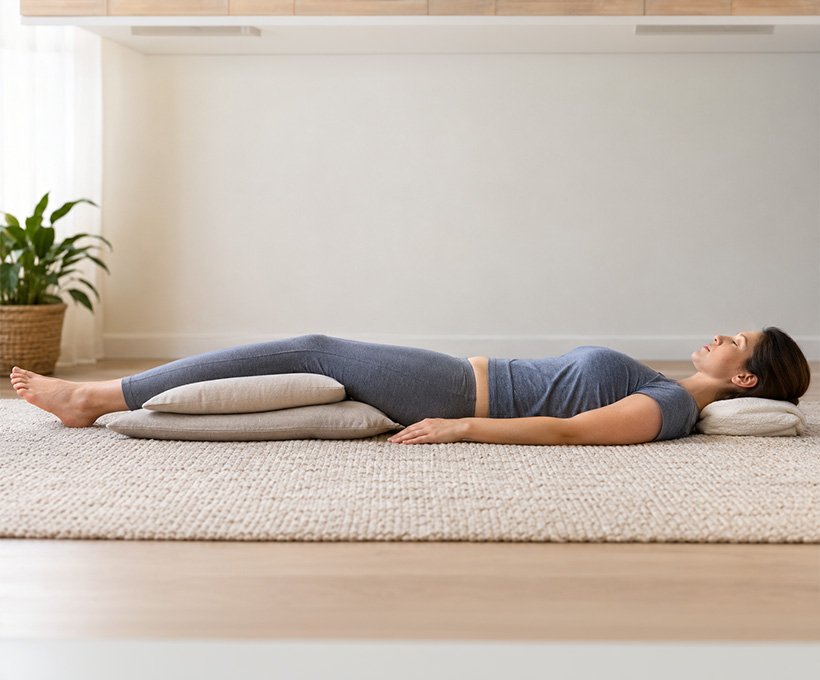
The Position of Comfort is the basic resting position for your back taught by Dr. Reaume Carroll Mulry. With the back straight and knees bent, the position provides relief from the downward pull of gravity on the spine and helps reduce unnecessary tension in the back.
Dr. Mulry used the Position of Comfort with Soft Stomach Breathing and Relaxation Therapy as one of the foundational skills in his approach to Backcare.
Lie on your back and bring your knees into a bent-knee position. Dr. Mulry taught that bending the knees helps straighten the lower back and reduce tension in the muscles.
Place one or two pillows under your knees for support. A small pillow or rolled towel under your neck can also provide support and help you relax with your spine in a straight-line position.
Rest your hands lightly on your stomach or by your sides, whichever feels most comfortable. Avoid crossing your legs or placing your arms behind your head, which Dr. Mulry taught could interfere with circulation and create unnecessary tension.
Once you are comfortable, begin Soft Stomach Breathing. Slowly inhale through your nose to a count of four, allowing your stomach to expand. Hold the breath briefly. Then slowly exhale through your mouth to a count of eight or so and relax.
Take several Soft Stomach Breaths and allow yourself to gradually settle into relaxation.
Dr. Mulry also emphasized how you move into and out of the Position of Comfort.
To lie down, move slowly from standing onto one knee, then onto your shoulder before rolling onto your back. When returning to standing, roll onto your shoulder, tighten your stomach muscles, rise to one knee, and then slowly return to the standing position.
This connects the Position of Comfort with a larger principle taught throughout Dr. Mulry’s Backcare programs: caring for your back includes not only the position you use, but how you move into and out of it.
If lying on your back is uncomfortable, Dr. Mulry also taught that you can use the Position of Comfort while lying on your side.
Bend your knees and position yourself so your spine remains straight. If your waist is narrower than your hips and shoulders and your body sags at the waist, place a pillow at your waistline for additional support.
The goal remains the same: a comfortable resting position with the spine supported and aligned.
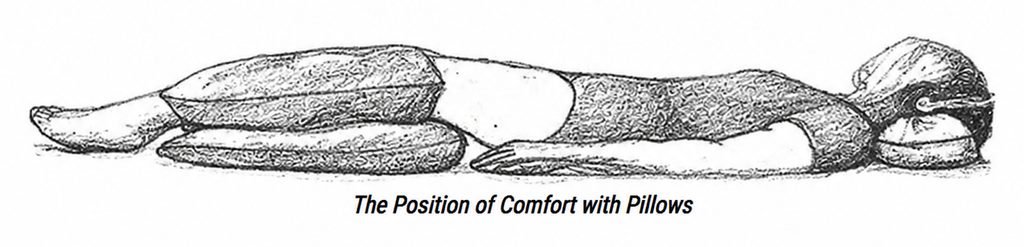
The Position of Comfort was one of the first practical skills taught in Dr. Mulry’s Freedom From Back Pain program. In The Centered Human Being, it follows Soft Stomach Breathing and becomes the resting position used to practice Relaxation Therapy.
As Dr. Mulry later explained in In The Zone: Making Winning Moments Your Way of Life, the horizontal position provides relief from the downward pull of gravity on the spine. Supporting the knees and neck helps you relax with the spine in a straight-line position.
The Position of Comfort also serves as a starting and returning position for several of Dr. Mulry’s stretching and strengthening exercises. Together with the Position of Strength, it forms part of the practical approach to relaxation, correct movement, flexibility, and strength taught throughout his Backcare programs.
