Not sure where to start?
Try the Personal Concerns Inventory (PCI) to clarify what to focus on, or start with Relaxation Therapy for guided meditation.

Social Learning Theory (SLT) is a foundational theory in psychology that explains how behavior is influenced by goals, expectations, values, and the situations we experience.
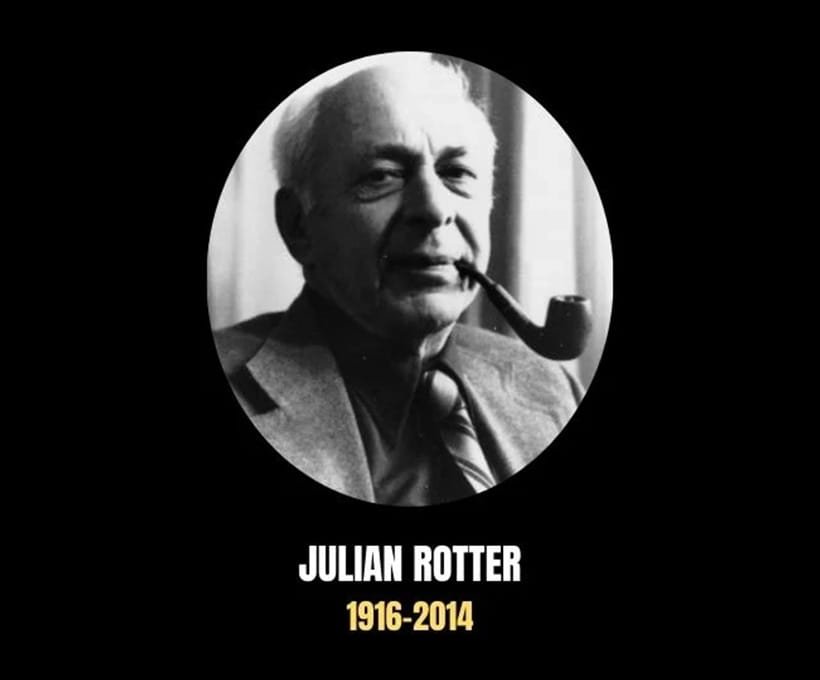
While Albert Bandura’s Social Learning Theory emphasized how people learn through observation and modeling, psychologist Julian B. Rotter developed a different approach focused on how expectations, values, and situations influence the choices people make.
Rotter’s theory introduced four important constructs:
Together, these concepts created a measurable framework for understanding goal-directed behavior. Rotter’s work also provided the foundation for research on Internal Locus of Control, the belief that our actions and choices can influence outcomes.
Julian Rotter’s Social Learning Theory deeply influenced Dr. Mulry, who studied under Rotter and developed a close friendship and professional relationship with him that continued throughout their lives. The theory’s emphasis on measurable behavior, expectations, and the relationship between actions and outcomes became an important foundation for the Mulry Method.
To see how Rotter’s Social Learning Theory connects with the Mulry Method, explore Social Learning Theory And The Mulry Method.
Julian B. Rotter was one of the most influential psychologists of the twentieth century. During the 1950s at Ohio State University, he developed Social Learning Theory by combining ideas from behaviorism with personality theory.
In 1954, Rotter published Social Learning and Clinical Psychology, introducing a framework that explained behavior through reinforcement, expectations, and interpretation of situations.
His work helped establish a more scientific approach to understanding personality and behavior. Rotter later served in leadership roles within professional psychology organizations and received the APA Distinguished Scientific Contribution Award in 1989.
His research continues to influence modern psychology, especially the study of motivation, behavior change, and Internal Locus of Control.
A central assumption of Rotter’s Social Learning Theory is that people are goal-directed. We make choices based on what matters to us and what we expect will happen within a particular situation.
Rotter explained this process through four key constructs.
Reward Value refers to how much a person prefers one outcome over another.
For example, someone may value learning piano more than learning guitar. That preference influences where they choose to invest their time and effort.
Understanding Reward Value helps clarify what matters most to us. When people identify their priorities, they can make choices that better align with their goals.
The Personal Concerns Inventory (PCI) supports this process by helping individuals identify concerns, preferences, and areas of importance. Even familiar concepts such as love can have different meanings and values for different people, as explored in A World Without Love.
Behavioral Potential refers to the likelihood that a person will engage in a specific behavior in order to achieve a goal.
If playing piano is highly valuable to someone, Behavioral Potential includes the actions they take to develop that skill, such as practicing regularly and seeking instruction.
Behavior does not happen randomly. It reflects the relationship between what we value, what we expect, and the situation we are experiencing.
Expectancy refers to a person’s belief that a behavior will lead to a desired outcome.
High expectancy sounds like:
“My effort can make a difference.”
Low expectancy sounds like:
“Nothing I do will change the result.”
Expectancy influences whether we take action or avoid a challenge. Realistic expectations help support persistence, learning, and Focused Action.
Rotter also used Freedom of Movement to describe generalized expectations for success across situations. High Freedom of Movement reflects confidence that your actions and abilities can lead to positive outcomes, while recognizing that expectations can vary depending on your skills and the situation.
The Psychological Situation refers to how a person interprets the environment they are in.
Two people can experience the same situation but respond differently because they understand and evaluate it differently.
For example, someone trying to change a habit may struggle if their daily environment repeatedly encourages the behavior they are trying to reduce. Understanding the Psychological Situation helps reveal which circumstances support progress and which create barriers.
Rotter summarized his theory through the formula:
BP = f (E & RV) in PS
Behavioral Potential is a function of Expectancy and Reward Value within a specific Psychological Situation.
In simple terms, the actions we choose depend on what we value, what we believe is possible, and how we interpret the situation around us.
One of Rotter’s most influential contributions was the concept of Locus of Control.
Locus of Control describes how people explain the relationship between their actions and the outcomes they experience.
Internal Locus of Control does not mean that people control every outcome. Instead, it reflects the belief that personal actions can influence results.
Research on Locus of Control has examined its relationship with persistence, coping, motivation, and perceptions of personal control.
This distinction is central to the Mulry Method concept of Learn To Teach – Teach To Learn, where learning becomes an active process of developing skills and recognizing the connection between actions and outcomes.
Rotter’s Social Learning Theory provides a practical framework for understanding behavior and creating meaningful change.
Understanding what we value and expect can help us recognize the factors shaping our choices.
Several of the self-care tools grounded in psychology within the Mulry Method apply these ideas directly:
For a deeper exploration of Internal Locus of Control, see The Science Behind Internal Locus of Control.
For Bandura’s model of observational learning and modeling, see Albert Bandura’s Social Learning Theory.
You can also explore Positive Performance Psychology: Reconfiguring Consciousness, Dr. Mulry’s guide to applying Social Learning Theory, Polyvagal Theory, and Internal Locus of Control through practical skill development.
Julian Rotter’s Social Learning Theory continues to provide a useful framework for understanding how people make decisions, pursue goals, and develop a sense of control over their lives.
His theory showed that behavior cannot be understood by looking at actions alone. What people value, what they expect to happen, and how they interpret a situation all influence what they are likely to do.
That principle became an important foundation of Dr. Mulry’s work. The Mulry Method carries it into practice by helping people learn from experience, recognize the relationship between actions and outcomes, and develop the skills needed for Self-Learning and Focused Action.
